

USGA equipment compliance means a club or ball has been submitted to the USGA and/or The R&A, evaluated against the Equipment Rules, and determined to conform to the Rules of Golf. The Equipment FAQ confirms that the Equipment Database identifies all submitted models and their conformance status.
Three facts every player should know:
- What it means: A conforming item meets the technical standards in the Equipment Rules. A nonconforming item may not be used when a competition committee has adopted the relevant Model Local Rule.
- Where to check: The USGA Equipment Database lists conforming driver heads, golf balls, and groove specifications for irons and wedges.
- Who is responsible: The player. Rule 4 places the burden of using conforming equipment on the individual, not the manufacturer or the committee.
Key Takeaways
USGA equipment compliance is a player responsibility: check the Equipment Database, confirm the event’s Local Rules, and resolve any ATR status before competition begins.
| Point | Details |
|---|---|
| Compliance is player-owned | Rule 4 places the burden on the player, not the manufacturer or committee. |
| Three lists to know | Driver heads update weekly; golf balls update monthly; the Informational Club Database covers groove specs. |
| ATR means individual testing | A model-level ATR result is not a passing grade when a Local Rule is in effect. |
| Alterations reset conformance | Any purposeful change to a club’s playing characteristics requires a new conformance evaluation. |
| Local Rules determine enforcement | G-1, G-2, and G-3 must be adopted by the committee; without them, mandatory listed-equipment rules do not apply. |
Table of Contents
- What does USGA equipment compliance mean for different club types?
- How do the USGA Equipment Database and Conforming Lists work?
- How does the USGA test and approve equipment?
- When does compliance become mandatory in competition?
- How do alterations affect a club’s conforming status?
- How to verify your equipment before an event
- Why equipment care and compliance go together
- Sources
What does USGA equipment compliance mean for different club types?
The Equipment Rules cover every category of club and ball a player carries. Rule 4 divides the requirements into three areas: Rule 4.1 for clubs, Rule 4.2 for balls, and Rule 4.3 for other equipment such as distance-measuring devices and training aids.
Clubs must conform in form and make. The R&A’s Part 2 conformance rules specify permissible materials, moving parts, and adjustment mechanisms. Spring effect on club faces is measured using the Pendulum Test Protocol, which quantifies how much energy a face returns to the ball. Driver heads, fairway woods, hybrids, irons, and wedges all fall under these specifications. Putters are submitted for evaluation but do not appear on the List of Conforming Driver Heads.
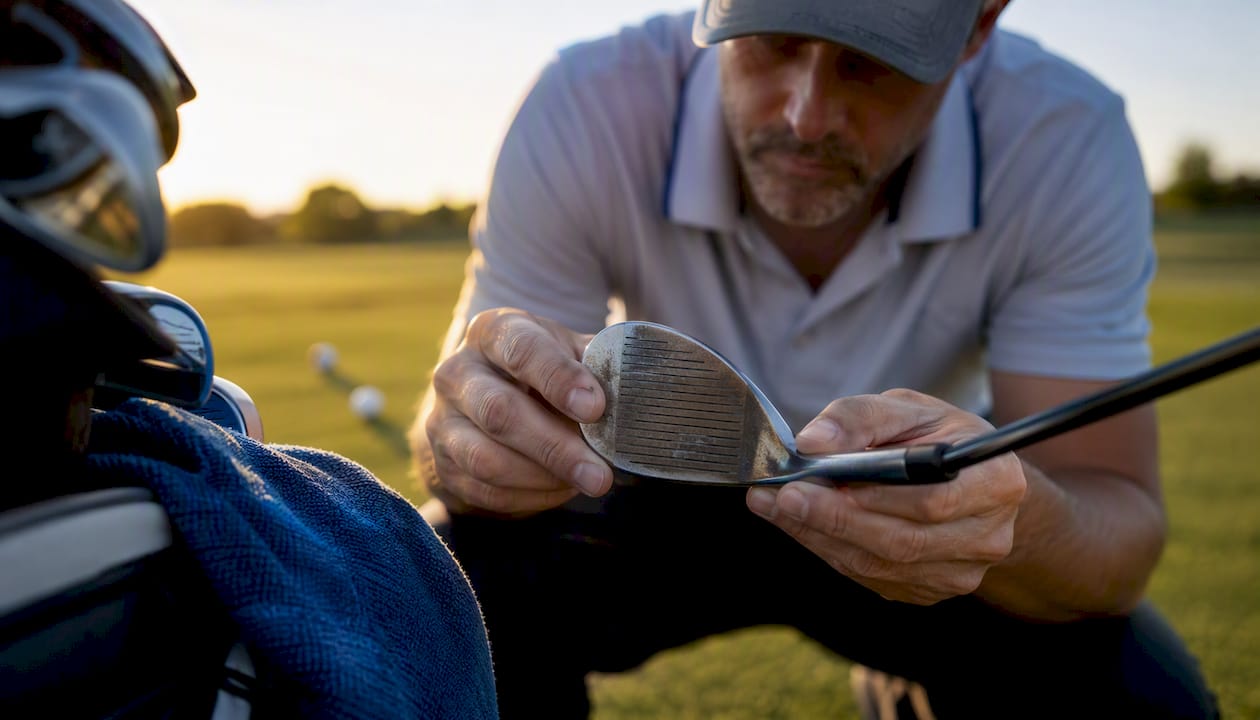
Groove rules apply specifically to irons, wedges, and any club with a loft above 25 degrees. Clubs manufactured on or after January 1, 2010 must meet the tighter 2010 groove specifications. Clubs made before that date may conform to the older pre-2010 standard, but only until a committee adopts Model Local Rule G-2.
Adjustable clubs are permitted, provided any adjustment requires a special tool and the club can be fixed in a stable position. Changing playing characteristics during a round is prohibited.
One distinction matters more than most players realize: a club that conformed when new remains conforming after normal wear. Purposeful alteration is treated differently. Any intentional change to a club’s playing characteristics makes it a “new” club in the eyes of the rules, and it must conform in its altered state.
How do the USGA Equipment Database and Conforming Lists work?
The USGA maintains three primary resources for checking golf equipment compliance. Each serves a different purpose, and knowing which one to use saves time before an event.
| List / Database | What It Covers | Update Frequency |
|---|---|---|
| List of Conforming Driver Heads | Driver heads submitted and found conforming | Weekly |
| List of Conforming Golf Balls | Golf balls submitted and found conforming | Monthly |
| Informational Club Database | Groove/punch mark specs for irons, wedges, hybrids | As submissions are processed |
The Conforming Club and Ball Lists page explains how committees use these lists and what each status means. A result of “Yes” means the model conforms. “No” means it does not. “ATR” means additional testing is required because submitted samples produced mixed or inconclusive results.
ATR carries real risk. When a Local Rule is in effect, a player whose club or ball shows ATR cannot rely on the model-level listing as proof of conformance. The Informational Club Database makes this explicit: players with ATR models should arrange individual testing before competing under a groove Local Rule. Treating ATR as a passing grade is a common mistake.
To search the Database, go to the USGA Equipment Standards page, select the relevant list, and enter the manufacturer name or model. Results are model-level, not serial-number-level, so individual clubs within a model can still vary.
How does the USGA test and approve equipment?
The submission and testing process at the USGA Research & Test Center follows a defined path. Players and manufacturers follow slightly different routes, but the core steps are the same.
- Prepare the submission. Manufacturers and designers submit equipment directly to the USGA Research & Test Center. Players who want a specific club checked can request testing through the player club testing information page, which lists contact details and submission requirements.
- Submit samples. Multiple samples of the same model are typically required. Inconsistent results across samples are what trigger an ATR status.
- Laboratory testing. The USGA applies the relevant test protocols. For driver faces, the Pendulum Test Protocol measures spring effect. Groove geometry is measured against the 2010 specifications for applicable clubs.
- Field testing. On-site evaluations are used at qualifying events. A field test for a single club takes less than 10 minutes; a full set can be evaluated in under 30 minutes.
- Receive the decision. The USGA’s testing guidance states that standard turnaround runs approximately two to three weeks. Expedited decisions are available for an additional premium.
- Database listing. Conforming models are added to the appropriate list at the next scheduled update.
Manufacturer submission is voluntary but strongly recommended. Equipment sold at retail without a prior conformance ruling shifts the risk entirely to the manufacturer and, ultimately, to the player who uses it.
When does compliance become mandatory in competition?
Conformance is not automatically required at every event. A competition committee must adopt a specific Model Local Rule to make listed equipment mandatory. Without that Local Rule, players may generally use any equipment that is not obviously nonconforming.
Model Local Rule G-1 requires that a player’s driver head appear on the List of Conforming Driver Heads. Elite amateur and professional events routinely adopt G-1. Most casual club competitions do not.
Model Local Rule G-2 requires clubs to meet the 2010 groove and punch mark specifications. When G-2 is in effect, pre-2010 clubs that only met the older standard are no longer permitted. This rule is common at elite amateur, collegiate, and professional events.
Model Local Rule G-3 requires that the ball used appear on the List of Conforming Golf Balls. Like G-1, this is standard at high-level events and less common at recreational rounds.
The practical difference is significant. A club-level Saturday medal round likely has none of these Local Rules in effect. A state amateur qualifier almost certainly has all three. Check the event’s conditions of competition before you arrive, not after.
Rule 4 places the penalty risk on the player. Using a nonconforming club or ball when the relevant Local Rule is in effect results in disqualification in stroke play or loss of hole in match play, depending on the specific violation.
How do alterations affect a club’s conforming status?
Normal wear does not affect conformance. Grooves that have worn smooth through regular play remain within the rules. The club conformed when new, and wear does not change that status.
Purposeful alteration is a different matter entirely. Re-grooving, sharpening groove edges, adding non-permitted face treatments, or attaching unauthorized devices all constitute intentional changes. Under Rule 4, the altered club is treated as a new piece of equipment and must conform in its changed state. A re-grooved wedge that now exceeds the permitted groove volume is nonconforming, regardless of what the original model’s Database listing says.
Adjustable clubs require attention during a round. Loft, lie, and weight adjustments are permitted between rounds, not during one. Any adjustment made mid-round must use the required special tool, and the club must remain in a stable, locked position while in play. Changing playing characteristics on the course is a Rule 4 violation.
If a club fails a field test during an event, the player must immediately remove it from play. Continuing to use a club after a nonconformance finding compounds the penalty.
How to verify your equipment before an event
Use this checklist before any competition where Local Rules may be in effect.
- Search the Equipment Database. Go to the USGA Equipment Standards page and check each driver, iron, and wedge model against the relevant list. Note any ATR results.
- Read the event’s conditions of competition. Confirm which Model Local Rules (G-1, G-2, G-3) are in effect. This information is typically posted on the event’s entry form or the club’s notice board.
- Resolve ATR clubs before the event. Contact USGA Equipment Standards or submit the specific club for individual testing. Standard turnaround is approximately 15–20 days, so plan ahead.
- Contact the committee if uncertain. The committee in charge of the event can clarify which Local Rules apply and whether a specific club or ball is permitted.
- Request player testing if needed. The player club testing page provides contact details and submission instructions for individual club evaluations.
Pro Tip: Resolve any conformance question before the qualifying round starts. Post-round testing can confirm a violation, but it cannot undo a penalty already incurred. If a club’s status is unclear, leave it out of the bag until you have a written conformance decision.
For additional background on golf equipment rules and how they affect players at different competition levels, the Jaguargolf blog covers Rule 4 and player responsibility in detail. Players preparing for their first competitive event may also find the caddie-approved gear checklist useful for pre-round preparation.
Why equipment care and compliance go together
At Jaguargolf, the focus on quality headcovers comes from a straightforward observation: clubs that are properly protected arrive at inspection in the condition they left the factory. Groove geometry is one of the first things a field inspector examines, and physical damage from bag chatter or unprotected storage can alter groove edges in ways that complicate that inspection, even when no intentional alteration occurred.

A quality headcover does not make a nonconforming club conforming. What it does is prevent the kind of incidental wear and contact damage that raises questions during an on-course evaluation. Protecting your investment and protecting your conformance status are the same action.
Sources
For immediate action, the Conforming Club and Ball Lists page is the fastest starting point for Database searches. For testing requests, use the player club testing page directly.


