

Perforated golf hats measurably improve airflow and reduce heat buildup during warm rounds, making them worth the switch for anyone who plays through warm weather. Jaguar Golf builds its hats around laser-perforated panels, moisture-wicking sweatbands, and structured fits that keep ventilation and sun coverage in balance rather than sacrificing one for the other. Keep reading for a quick checklist on materials, fit, and care that will help you choose the right one.
TL;DR:
- Perforated golf hats with laser or micro-perforations improve airflow but may reduce sun protection and increase dust ingress in hot, sunny conditions.
- Choosing the right hat involves evaluating fit, sweatband quality, perforation density, closure type, and whether the fabric is soakable for maximum cooling in extreme heat.
- Fabric materials like micro-mesh and 4-way stretch knits offer better breathability and movement, while structured front panels help maintain shape during play.
- Proper cleaning includes hand washing with mild detergent, air drying, and shaping the hat while drying to preserve perforations and structure.
- Price varies based on fabric quality and features, with durable, high-performance designs costing more but offering better longevity through frequent summer use.
Table of Contents
- What are perforated golf hats and how do they cool your head?
- How do you choose the right perforated golf hat?
- What features and tech actually matter on a breathable hat?
- What should you test before buying a perforated hat?
- How do you clean and maintain a perforated golf hat?
- Which perforated golf hat brands and styles stand out?
- What should you expect to pay for a perforated golf hat?
- Jaguar Golf perspective: designing for airflow without sacrificing style
- Where to buy a Jaguar Golf perforated hat
- Sources
What are perforated golf hats and how do they cool your head?
A perforated golf hat uses small holes, cut by laser or built into the mesh weave, to let hot air escape from the crown before it turns your round into a sweat session. Laser perforation creates precise, uniform holes through structured fabric panels. Micro-perforations do the same job at a smaller scale, often across a wider surface area for subtler airflow. Mesh back panels go further, replacing solid fabric with an open knit that moves air constantly rather than just at pinholes.
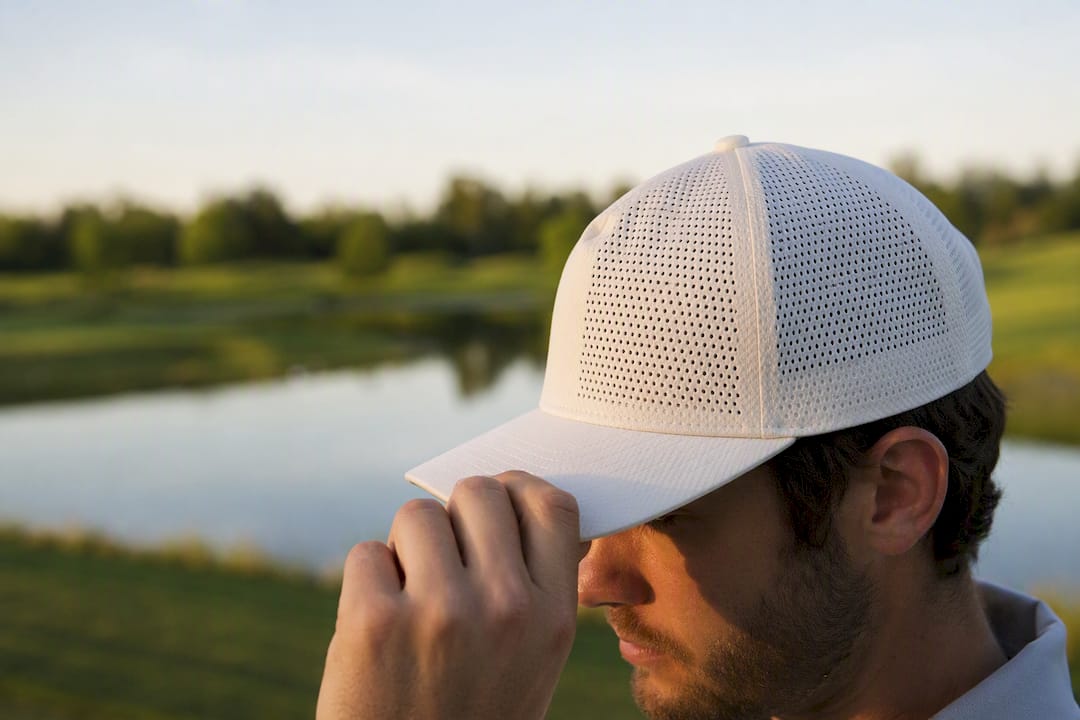
The physics is simple: heat and moisture rise off your scalp, and a solid crown traps both against your head like a lid. Perforation gives that heat somewhere to go. Golfers in community forums frequently name perforated and mesh caps as their default summer pick over solid-crown styles, citing the difference in how a hat feels by the back nine.
The tradeoff is coverage. Every hole that lets air out also lets a little more sun and dust in, which matters most in these situations:
- Peak summer rounds in humid or high-heat climates
- Walking courses without cart shade breaks
- Long tournament days with multiple rounds back to back
- Coastal or dusty courses where debris ingress is a real, if minor, concern
For shaded winter rounds or cooler climates, the ventilation benefit matters less and a solid crown might serve you better.
How do you choose the right perforated golf hat?
Picking the right hat comes down to five decisions, in this order of importance:
- Fit first. Check crown depth against your head shape, note whether the front panel is structured (stiffer, more shape-holding) or unstructured (softer, more breathable), and confirm the closure type fits your preference for snapback precision or stretch-fit ease.
- Prioritize the sweatband. A moisture-wicking sweatband pulls sweat away from your forehead instead of letting it pool and drip into your eyes mid-swing.
- Look for 4-way stretch fabric if you want a snugger, more athletic fit that moves with your head rather than shifting during your swing.
- Match perforation density to your climate. Denser perforation patterns and larger mesh sections mean more airflow but less structure and slightly less sun-blocking coverage. Lighter perforation preserves more shade at a small cooling cost.
- Consider soakable fabric for extreme heat. Soakable and evaporative cooling hats work by wetting the fabric before your round, and evaporation pulls heat away for hours. The catch is that they need reactivation as they dry out, and they’re not built for cooler or rainy conditions.
Before buying, scan the product page for specific language: “laser-perforated,” “moisture-wicking,” or “4-way stretch” are claims worth trusting, since they describe a manufacturing process rather than a marketing adjective. Vague claims like “breathable design” without any specifics are worth a second look. Shopping apps and storefronts that aggregate specs and reviews can help you cross-check whether a hat’s claimed features hold up in actual owner feedback.
Pro Tip: Try the hat on and tilt your head down like you’re addressing a putt. If the front panel collapses or the brim drops into your eyeline, the structure is too soft for consistent play.
What features and tech actually matter on a breathable hat?
Fabric choice drives most of the comfort difference between hats. Polyester blends are the standard for durability and shape retention, but micro-mesh panels and 4-way stretch performance knits move noticeably more air and flex with your head instead of fighting it.
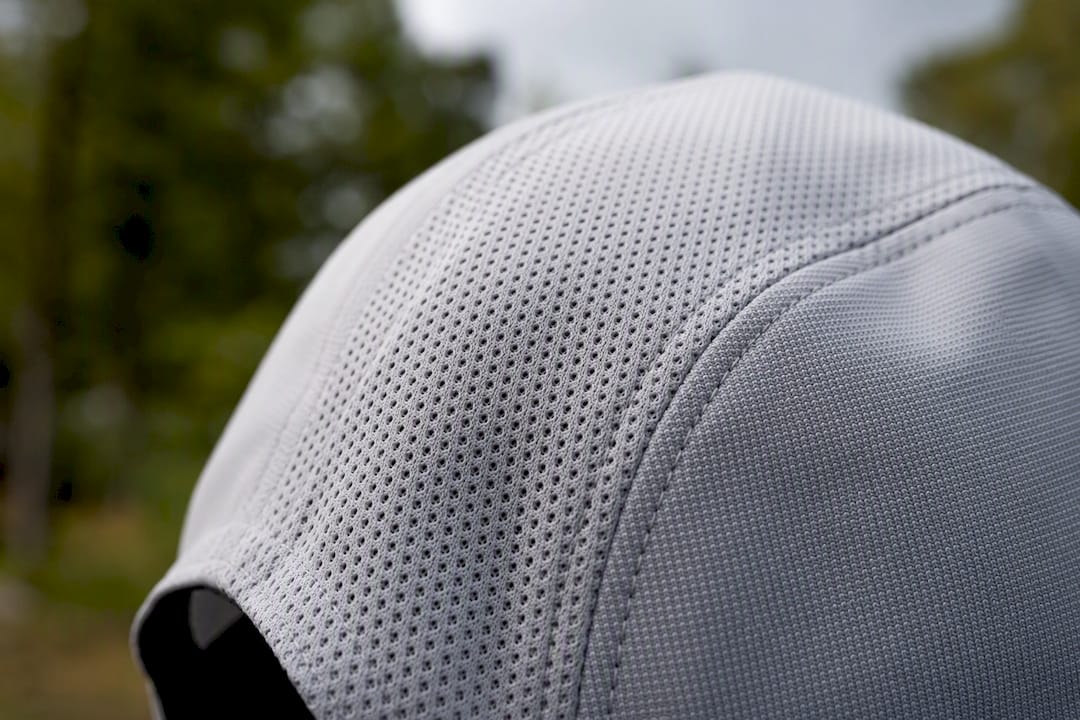
Sweatband construction matters more than most golfers realize. A thin, wicking sweatband disappears against your skin, while a padded version adds cushion but can trap heat if it isn’t treated with a wicking finish. Some higher-end hats add antimicrobial treatment to the sweatband, which slows the odor buildup that comes with repeated summer wear.
You’ll also see two different cooling philosophies on the market:
- Water-repellent exteriors shed light rain and morning dew while staying breathable underneath.
- Soakable, evaporative fabrics work the opposite way. You wet them deliberately, and evaporation does the cooling work.
These two approaches solve different problems, so check which one a hat is built for before assuming “cooling” means the same thing across brands.
UPF treatment deserves a closer look, too. A tightly woven crown can carry a UPF 50 rating, but adding heavy perforation for airflow can lower that effective rating since more ultraviolet light passes through the gaps. If sun protection matters as much as cooling to you, look at how a brand balances the two rather than assuming a high UPF number applies uniformly across a perforated design. Our UPF and brim guide breaks down how brim width and fabric weight affect that tradeoff in more detail.
Bill structure rounds out the picture. A stiffer, curved bill blocks more low-angle sun but can restrict peripheral vision on the green. A flatter, softer bill improves sightlines and airflow at the cost of some shade coverage.
What should you test before buying a perforated hat?
A hat that looks breathable on a product photo can still feel wrong on your head, so a few quick checks before purchase save you a return shipment.
Crown depth changes both airflow and how the hat sits relative to your sunglasses or sightline on the green. A shallow crown ventilates fast but can ride up during your backswing. A deeper crown holds more air but stays more secure through a full swing rotation.
Closure type affects ventilation more than most buyers expect. A snapback closure gives you a fixed, structured fit that holds perforation panels in the same position all day. A stretch-fit closure flexes with head movement but can compress mesh sections slightly, reducing airflow at the back panel.
Run through this quick check before you commit:
- Move your head side to side and nod as you would reading a putt. Nothing should shift or pinch.
- Press two fingers against the sweatband to confirm it sits flat with no bunching.
- Check brim clearance against your peripheral vision, especially on a full backswing.
- Confirm the closure has at least one adjustment notch of room for hat sizing to change with hair length, hydration, or temperature swings across a season.
Sizing runs differently across brands even at the same labeled size, so if you’re between two sizes on a chart, size down for a snapback and up for a stretch-fit, since stretch fabric tightens slightly with wear. Our fit guide walks through crown shapes and closures in more depth if you’re deciding between styles.
How do you clean and maintain a perforated golf hat?
Perforated hats need gentler care than a standard cap because the holes, coatings, and structured panels all degrade faster under rough handling.
- Hand wash first, machine wash only on a gentle cycle. Use mild detergent and cool water. Hot water breaks down water-repellent coatings and can warp structured front panels.
- Never wring the hat. Twisting stresses the perforated fabric and can widen or tear the holes over time. Press excess water out with a towel instead.
- Air dry away from direct heat. Skip the dryer and avoid leaving the hat on a dashboard or near a heater. Heat is the fastest way to shrink a crown or crack a coating.
- Use a hat form or shape it over a bowl while drying to preserve the crown’s original curve, especially for structured front panels.
- Check the sweatband every season. Once it stops wicking, or starts to smell no matter how often it’s washed, it’s a sign the antimicrobial treatment has worn off and it’s time to consider a replacement hat.
These steps line up with what most premium hat manufacturers recommend for gentle cleaning, since aggressive washing is the most common way owners shorten a hat’s usable life.
Which perforated golf hat brands and styles stand out?
The perforated hat market splits into a few clear categories rather than one dominant style. Laser-perforated performance caps use structured front panels with precisely placed holes, favoring a traditional golf silhouette with added airflow at the crown and sides. These work best for golfers who want a classic look without giving up ventilation.
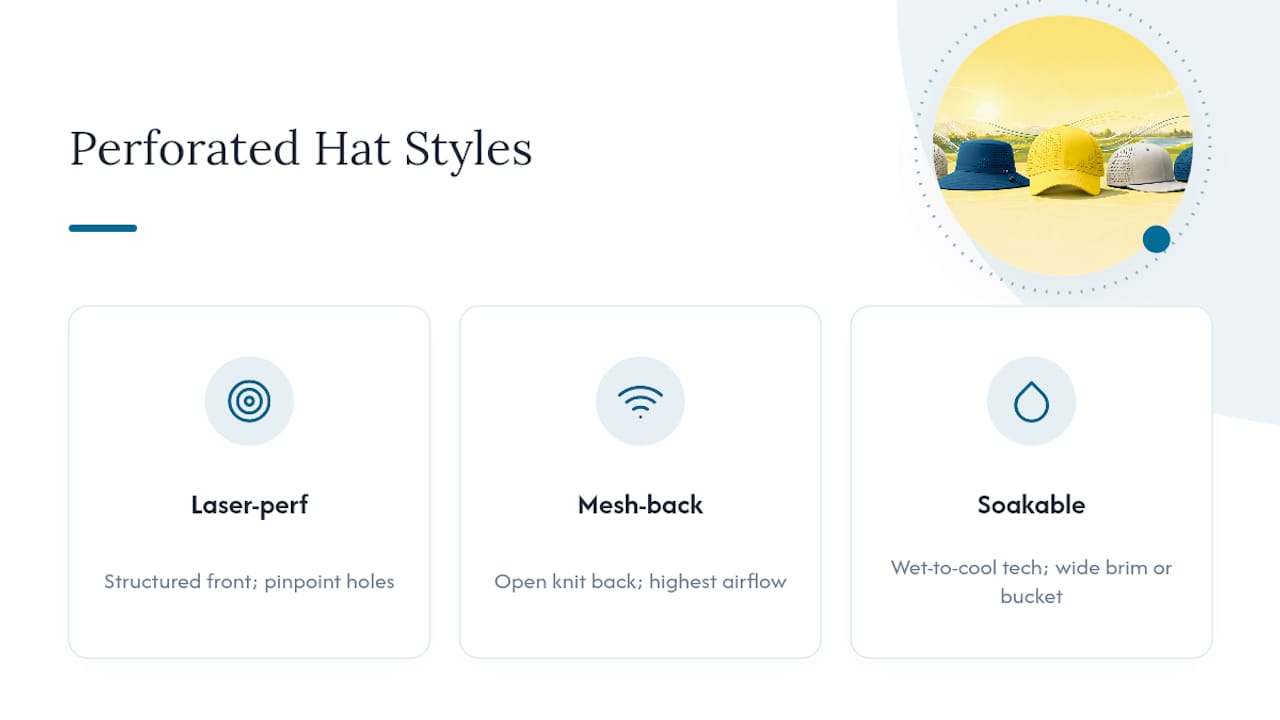
Full mesh-back designs trade more structure for airflow, using an open knit across most of the back panel while keeping the front more solid for logo space and shape retention. They run cooler overall but hold their form less rigidly through a full round.
Soakable and evaporative hats occupy a niche for extreme heat, sacrificing a traditional cap look for wide-brimmed or bucket-style coverage built specifically around wet-to-cool performance.
Jaguar Golf’s approach sits in the first category, favoring laser-perforated panels placed at the crown and temple areas where heat buildup is worst, while keeping the front panel structured enough to hold shape and support personalized designs. That’s a deliberate middle ground between a fully mesh-backed cap, which ventilates aggressively but looks less polished, and a solid-crown traditional cap, which looks sharp but runs hot by the fourteenth hole. Community feedback on performance and tech perforated hats consistently flags this fit-versus-airflow tradeoff as the deciding factor between styles, more than brand name alone.
What should you expect to pay for a perforated golf hat?
Perforated and performance golf hats typically fall within a moderate price range, with the spread driven mostly by fabric quality and construction detail rather than brand recognition alone.
At the lower end, expect basic polyester perforation with a standard sweatband and simple snapback or Velcro closure. These get the airflow job done but tend to show wear faster, especially around the perforated panels and closure hardware.
The middle and upper range is where 4-way stretch knits, antimicrobial sweatbands, water-repellent coatings, and reinforced perforated panels show up. This is also where personalized or design-forward options tend to sit, since better base materials hold custom prints and embroidery more cleanly over repeated washes.
Soakable and evaporative-cooling hats often price similarly to premium perforated caps despite using a different cooling mechanism, since the specialty fabric and wide-brim construction cost more to produce than a standard mesh panel.
The real value question isn’t the sticker price. It’s cost per season of wear. A $30 hat that loses its sweatband wicking after two months of regular play costs you more over a golf season than a $55 hat built with reinforced stitching and a treated sweatband that holds up through repeated wash cycles. If you play more than once a week through summer, the mid-to-upper price range earns its cost back in durability alone.
Jaguar Golf perspective: designing for airflow without sacrificing style
Most perforated hats on the market treat ventilation and style as opposing goals. You either get a cap that breathes well and looks generic, or one that looks sharp and runs hot. Jaguar Golf’s design philosophy rejects that tradeoff outright, and the placement of perforation panels is where that shows up most clearly.
We place laser-perforated sections specifically at the crown and temple, the two points where heat buildup happens fastest during a walking round, while keeping the front panel structured enough to hold a clean shape and support the personalized designs golfers actually want to wear off the course too. That’s a deliberate engineering choice, not a cosmetic one. A hat that vents everywhere loses its structure fast; a hat that vents nowhere just traps heat.
What gets underestimated in most buying advice is how much closure type affects perceived breathability. Two hats with identical perforation patterns can feel completely different depending on whether the closure holds the crown in a fixed position or lets it shift with head movement. We’ve built our fits around that detail specifically, because ventilation on paper doesn’t matter if the hat doesn’t sit right for four hours of actual play.
The category doesn’t need more hats that chase one spec at the expense of everything else. It needs hats built for how golfers actually move, sweat, and swing across a full round, in whatever conditions that round happens to fall on.
— Josh
Where to buy a Jaguar Golf perforated hat
Jaguar Golf builds its perforated hats around the exact criteria covered above: laser-perforated panels at the crown and temple, moisture-wicking sweatbands, and structured front panels that hold shape through a full round without sacrificing airflow. If you’ve been shopping around and comparing specs on other sites, this is the same checklist applied with a design-forward finish.
Before you check out, look at the product page for three things: the specific perforation placement, the sweatband material, and the closure type, since those three details tell you more about real comfort than a generic “breathable” label ever will. Browse the current lineup on the Jaguar Golf hats collection to compare fits and finishes side by side, and reach out to customer support directly if you’re unsure which crown depth or closure suits your head shape. A quick message before you buy is faster than a return after a hot, uncomfortable round.
Sources
The technical claims on cooling mechanisms and real-world hat performance in this guide draw from a small set of sources worth a closer look. The Aussie golf soakable mesh hat product page details how evaporative cooling fabric works and when it makes sense over standard perforation. The r/golf performance hat thread offers wearer-level detail on perforation tradeoffs, including dust ingress and shade loss that spec sheets rarely mention. The Tapcart storefront app listing illustrates how mobile shopping platforms aggregate product specs and reviews, useful when verifying a hat’s claimed features before buying.
- Aussie golf soakable mesh hat product page — Conner Hats
- Performance / Tech Perforated Hats : r/golf
- Tapcart app (example of mobile storefronts aggregating product specs)


